Fairy Tale Therapy: Part 1

Updated: 3 days ago
The Tale of the Handless Maiden
Somatic Work for Trauma Using Fairy Tales
There is a reason these stories were told around firepits, at water wells, in weaving circles. The people who passed them forward weren't entertaining each other. They were doing something far more serious. They were mapping the interior landscape — encoding the movements of the psyche in story form so that the knowledge could survive, generation to generation, even when the formal language to describe it was forbidden, unavailable, or simply hadn't been invented yet.
We have largely lost this. We live in a culture that has traded the firepit for the self-help section, and in doing so, we have traded something irreplaceable: the container.
A container is not a solution. It is not a prescription. It is not a set of instructions for how to live better.
A container is a vessel strong enough to hold what cannot yet be named — the grief

that has no origin story you can point to, the rage that predates your own memory, the longing that no relationship has ever quite satisfied. Fairy tales were built to hold exactly these things.
And here is what makes them different from therapy, from self-help, from every twelve-step program ever written:
These tales are not about self-improvement.
Read that again. Remember it.
If you walk away from this story thinking I will try never to do that to my children — you have missed the point entirely. If you walk away thinking I need to protect myself from tricksters — you have missed the point. If you walk away with a plan, a resolution, a lesson learned — the story has not yet reached you.
These tales are maps of the collective and individual psyche. They were crafted not to prevent suffering but to give suffering meaning and shape — to show us that what feels like annihilation is often the very beginning of transformation.
A Word on Masculine and Feminine
Before we enter this story, we need to clear something up — because these words carry so much cultural noise that they can obscure everything that follows.
In Jungian terms, masculine and feminine are not about gender. They are about energetic principles that exist within every human psyche, regardless of the body you inhabit.
The masculine principle is solar — outward-facing, goal-oriented, structuring, separating, naming, building in the world. The masculine principle is the one that shows the child how to (and that they can) be in the outer world.
The feminine principle is lunar — inward-facing, relational, generative, cyclical, feeling, connecting, gestating in the dark. The feminine principle is the one that shows the child how to (and that they can be) in their inner world.
Every psyche contains both. Every culture expresses both — or suppresses one at its peril.
What this story maps is what happens when the feminine principle is systematically devalued — not by mustache-twiddling villains, but by the well-meaning, the unconscious, the ordinary. By fathers who simply didn't know. By mothers who saw but didn't act. By a culture that has been doing this so long, it no longer even notices.
This is a collective wound. And it lives — with exquisite specificity — in individual bodies.
The Tale of the Handless Maiden: Part One
"There was once a miller who had fallen on hard times. His mill was broken down, and he and his wife lived in poverty. One day, at the edge of the forest, he met an old man — the devil in disguise — who made him an offer: give me what stands behind your mill, and I will give you more wealth than you have ever known.
The miller thought of the old apple tree behind the mill and agreed without hesitation.
Instantly, his fortunes changed. A fine home. Treasure beyond imagining.
But his wife knew immediately. She knew it was not the apple tree the old man had wanted. It was their daughter — who had been sweeping back there — that the devil had come for.
Three years later, the devil returned. But the girl drew a circle of chalk around herself,
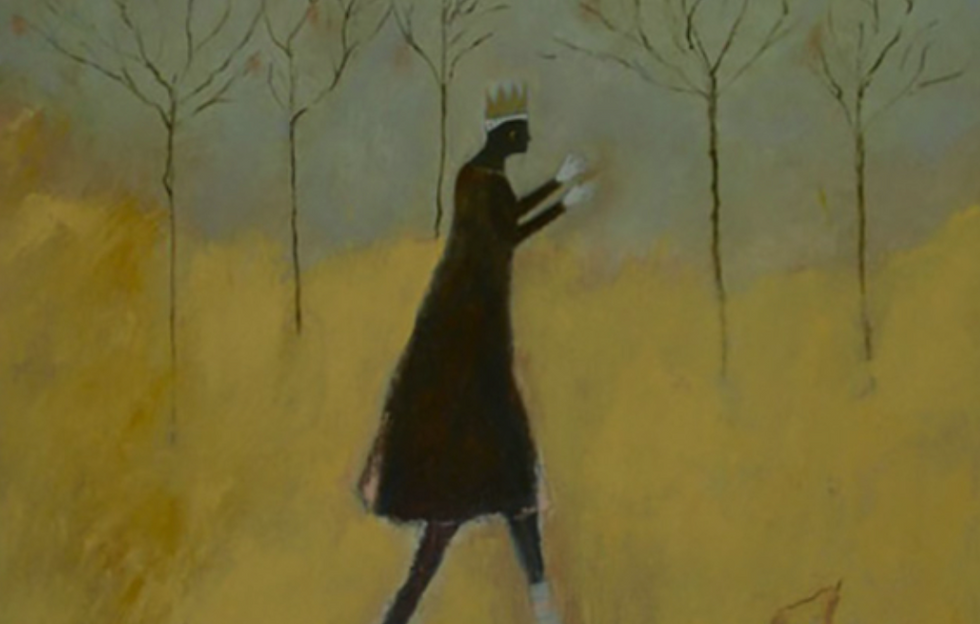
and he could not reach her. Furious, he ordered the miller to take away everything with which she could wash herself clean. The miller obeyed. But the girl wept — and her tears fell onto her hands and washed them clean. For the second time, the devil could not take her.
The devil ordered the miller to cut off her hands. Or he, the miller, would die.
The miller wept and begged his daughter's forgiveness.
And the daughter said:
Father. Do it. Cut them off.
He did. And she wept onto her stumps, and washed them clean with her tears. And when the devil came for her a third time — he still could not have her. Three times he had tried. Three times he had failed. He left without his prize, vowing revenge.
The miller, stricken with guilt, promised his daughter every comfort for the rest of her days. They were wealthy now. She would want for nothing.
But the daughter refused.
She bound her severed arms to her body and walked out into the forest alone." Stay tuned for Part 2!
The Symbols That Map The Soul
Every fairy tale is layered. What sits on the surface — the miller, the devil, the severed hands, the forest — is never what it appears to be. Each element is a symbol, compressed and alive, carrying more meaning than a single reading can exhaust.
In the next section, we break apart the symbols of The Handless Maiden: Part One. For each symbol, you will find questions for the mind, which wants to understand — and questions for the body, which already knows.
Do this work slowly. Some of it will land lightly. Some may uncover you in unexpected places.
The Broken-Down Mill: A Fractured Psyche
In Jungian dream interpretation, setting is everything. The landscape you find yourself in is not a backdrop — it is the condition of the psyche itself.
The story does not begin in a palace, a village, or a prosperous farm. It begins in a

broken-down mill — a place once meant to grind grain into sustenance, to transform raw material into nourishment, but has fallen into disrepair. It no longer works. It no longer produces.
This is the psyche we are entering. Not an evil psyche. Not a corrupt one. A broken one — one that has lost its capacity to metabolize experience into meaning. A psyche that is running on fumes, on old patterns, on the exhausted hope that something outside itself will restore what has been lost from within.
Where in your own life do you recognize the broken-down mill? Not as a failure — but as a starting condition. Where has your capacity to transform experience into meaning gone quiet?
The Miller: The Ignorant Father and the Wound of the Masculine
The miller is not a villain. This is important.
He is not cruel. He is not malicious. He is not even particularly foolish by ordinary standards — he is simply a man operating entirely within the logic of the outer world: I have nothing. Someone is offering me something. I will take it. He does not ask what he is trading. He does not consider what stands behind the mill. He does not consult his wife, his daughter, his own deeper knowing.
He is ignorant — in the most precise and devastating sense of the word. He ignores.

In Jungian terms, he represents the wounding father — the masculine principle that has become entirely identified with the outer world and has lost all connection to the inner.
He has no relationship to the apple tree. No sense of what it represents. No understanding that the generative, cyclical, living feminine principle in his own backyard is worth more than any treasure the outer world can offer.
And so he trades it. Casually. Without knowing what he's done.
This is the shadow of patriarchy — not the cartoon villain with the whip, but the ordinary man who simply never learned that the inner world exists, that the feminine principle has value, that what cannot be monetized or measured is not therefore worthless. He passes this ignorance on — not through cruelty but through absence of knowing — and the cost is borne entirely by the daughter.
This wound is collective. It is in the water. It is in the air. It is in every institution, every economy, every culture that has systematically elevated the solar at the expense of the lunar — production over gestation, achievement over relationship, having over being.
And it is also deeply personal.
Think of the father figures in your own life — biological, cultural, institutional. Where did they trade the apple tree without knowing it? Where did their ignorance — not their cruelty — cost you something you are still trying to name?

Somatic Mapping: Intro
After each section, I will present you with an opportunity for somatic inquiry. This work can help you map your physical responses to the material presented. These physical responses can feel overwhelming - but they can also be the key to integration.
If any of the somatic work feels triggering, please reach out.
The Apple Tree: What Was Traded Without Knowing
The apple tree is not incidental. Nothing in a fairy tale is incidental.
The apple tree is one of the oldest symbols in the human imagination — the Tree of Life, the axis mundi, the self-generating, self-renewing, fractal principle of existence itself. It flowers. It fruits. It seeds. It returns. It does not need to be told to do this. It simply is this.
It is a symbol of the generative feminine principle — not as a role, not as a function, but as a fundamental quality of being. The capacity to create life, to nourish, to cycle through seasons without losing essential nature, to offer fruit without being diminished.
The miller has this in his backyard. He has had it all along. And he trades it for a fine house and some gold — not even knowing he's done it.
This is the trade that has been made, collectively, for centuries. The lunar for the solar. The generative for the productive. The tree for the mill — and then even the mill breaks down.
In the culture of your family — the unspoken rules, the things that were praised and the things that were shamed — which feminine principles were quietly traded away?
The capacity for rest and cyclical renewal? The understanding that fallow seasons (unproductive times) are not a failure?
Somatic Mapping: The Apple Tree
Take a breath and let your attention move inward — not to a thought, not to a memory, but to the quality of aliveness itself. The fact that you are here, breathing, that your heart is moving blood through a complexity so vast and intricate it will never be fully mapped. That you are, in this moment, a temporary and astonishing arrangement of matter that somehow knows it exists.
Notice if there is anywhere in your body where that lands as something more than information.
Some people feel it as a tingling — a subtle electricity across the skin or behind the sternum. Some feel it as a sudden sense of interior spaciousness, as though the body is larger on the inside than the outside. Some feel it as a quiet excitement with no object, a aliveness that isn't about anything in particular. Some feel it as awe — and awe has a shape, if you look for it. Not hollow. Not empty. Vast. Lit from within. The feeling of standing at the edge of something that has no edge. The great mystery is waiting for you to come into a relationship with it.
The Devil: Aka The Indespensible Trickster
Here is where we must resist the instinct to make this simple.
The devil is not the enemy of this story.
The devil — the trickster, the shadow, the necessary disruptor — is the spark that lights
the fire of individuation. Without him, the miller's daughter remains in the backyard sweeping. Innocent. Untested. What Jung would call puella — the eternal girl, all potential and no depth, all sweetness and no substance.
Think of Snow White. Lovely. Passive. Waiting. Endlessly, infuriatingly positive. The kind of innocence that has never been asked to become anything.
The trickster ends that. The trickster has to end that — because the soul has a desire

for its own self-knowledge that is more powerful than any desire for safety. The psyche will generate the very conditions required for its own transformation, even when the conscious mind would choose comfort every single time.
This is not a cautionary tale about avoiding the devil. You cannot avoid the devil. The bargain has already been made — in your family of origin, in your culture, in the long history of the collective psyche. The trickster is not something that happens to unlucky people. The trickster is the mechanism by which the psyche insists on its own wholeness.
The question is never "How do I prevent this?" The question is always, "What does this initiation require of me?"
Where has the trickster appeared in your own life — the loss, the betrayal, the collapse that you could not have chosen but that set something essential in motion? Can you locate, even dimly, what it started?
Somatic Mapping: The Trickster
Before you move to the question, pause. Scan your body slowly — not looking for anything in particular, just listening.
The inner change brought on by the trickster does not always announce itself as a place of fear. Sometimes it is a subtle resistance — a stiffening in the shoulders, a guardedness across the chest, a stomach that tightens slightly around something it cannot name. Sometimes it is the impulse to skip ahead, to move quickly past this section, to decide intellectually that you understand it without letting it land.
That impulse to move away — that is worth staying with.
Where in your body do you feel resistance right now? Not resistance to the story, but resistance to something the story is pointing at in you. A place that has gone slightly hard, slightly braced, slightly still.
This is a threshold your psyche guards most carefully — because what is on the other side of the resistance is not destruction. It is change. And the body, wise and ancient, knows that change and danger feel almost identical.
You are afraid of something becoming. That is not weakness.
That is how every necessary transformation begins
The Mother: The Wound of the Feminine Witness
The mother sees. She knows immediately. She understands what her husband has done, what has been traded, who the old man really was.
And she does nothing.
This is the second betrayal — quieter than the first, and in some ways more devastating. Because the mother represents the feminine principle that has enough

consciousness to perceive the danger but not enough power — or will — to intervene. She is aware but ineffective. She witnesses but does not act.
This is not a character flaw. It is a collective condition. When the feminine principle has been systematically devalued for long enough, even those who carry it most fully can lose faith in their own authority to protect what they know must be protected. The mother has been living in the broken-down mill, too. She has been shaped by the same world that made the miller who he is.
Her failure is not personal. It is the wound of a culture in which feminine knowing — intuitive, relational, lunar — is acknowledged privately and disregarded publicly. She knew. And knowing was not enough.
Where have you experienced this — the witness who saw, who perhaps even named what was happening, but could not or did not intervene? And where, perhaps, have you been that witness yourself?
Somatic Work: A Mother Wound
Sit for a moment with what you just read. Don't move toward an answer yet.
Notice first what happened in your body as you read. Was there a withdrawal — a subtle pulling inward? A closing off, like a door quietly shutting somewhere in your chest? A heaviness that settled without announcement, the way grief does when it has been carried so long.
Or perhaps the opposite: a careful blankness. A smoothing over. The body's practiced way of making certain things bearable.
Place one hand gently over the center of your chest. Not to fix anything. Not to perform comfort. Just to mark the place.
Because the mother wound lives here — in the place that first reached outward for attunement and learned, in ways large or small, to manage the distance it found instead. The body remembers every calibration it made. Every hunger it learned to quiet. Every moment it decided, without words, that needing was not safe.
You are mapping your inner landscape. This is enough for now. Be proud of you.
The Tears: Sanctifying Waters
Three times the devil comes. Three times the girl's tears defeat him.
This is not incidental. The tears are the most powerful force in this entire first chapter of

the story — more powerful than the chalk circle, more powerful than the miller's guilt, more powerful than the devil's cunning.
But we need to understand what kind of tears these are.
They are not the tears of victimhood — the helpless weeping of someone who has no agency, no recourse, no self. They are not the tears of resentment — the hot, closed tears of someone who has turned their suffering into armor.
These are what one scholar calls fructifying tears — tears that soften the ground for new growth. They are tears of acceptance — not passive resignation, but the profound, active receptivity of someone who has descended into the full weight of what is happening and has not looked away.
Tears that sanctify. Tears that purify. Tears that transform.
They are, in the deepest sense, tears of faith — not religious faith, but the bone-deep trust that suffering endured with full presence will not destroy what is essential. They hold the girl in the tension between the two extremes: endless passivity and seizing control in a way that forecloses feeling entirely. And in that held tension, something the devil cannot touch is preserved.
Grief, real grief — the kind that pulls us all the way down — is not weakness. It is the mechanism by which the psyche descends to the depths where transformation becomes possible.
Without the willingness to be broken open, there is no wholeness.
Where have you wept the fructifying tears? Or the tears that felt like they might kill you but didn't? And where have you armored against tears, choosing control or resentment because the grief felt too dangerous to enter?
Somatic Work: Tears of Redemption
Notice your jaw. Your eyes. The hinge of your throat.
These are the places the body holds what was never allowed to move. If there is tightness there — a clenching, a held quality, a sense of something pressed back — that is not weakness. That is years of learning to manage what should have been allowed to flow.
You don't have to cry. You don't have to feel anything in particular. Just notice what is held, and where. That noticing is enough for now.

The Hands: Agency, Feeling, and What Was Cut Away
Of all the symbols in this story, the dismembered hands may be the most devastating — because we know immediately, in our bodies, what they mean.
With our hands, we create, build, hold, release, offer, receive, pray, heal, work, touch. They are our primary instruments of agency in the outer world and our primary instruments of feeling in the inner one. They transmit a healing touch. They see/feel what eyes can't. They are how we are in touch — with the outer world, with each other, with our deepest selves.
To cut them off is to dismember the human capacity for feeling, agency, and connection all at once. It is the ego's worst fear made literal — the terror of being rendered incapable, dependent, unable to survive in the world as it is.
And yet.
She offers them herself.
Father. Cut off my hands.
This is the moment that changes everything — not the cutting, but the consent. She does not fight. She does not flee. She does not bargain. She looks at the impossible choice — be taken by the devil or lose her hands — and she chooses the loss that preserves her soul over the survival that would cost it.
This is not passivity. This is the first sovereign act of the story. It is the ego releasing its grip on the form it has known — the innocent girl who could sweep and reach and touch and do — in service of something it cannot yet name or see.
The cutting away of the hands is the death that precedes transformation. The ego believes it is dying. It may be right. But what dies is not the self — it is the limited self, the self that could only exist within the terms the broken-down mill had established.
She cannot stay in the outer world without hands. She has to go inward. She has to go into the forest.
Where have you experienced the cutting away of your hands — the loss of capacity to be in the world in the way you knew? Could this have been an initiation?
Somatic Work: The Hands that Give and Receive
Bring your attention to your hands.
Begin to massage one hand with the other — slowly, without agenda. The palm, the space between the fingers, the small bones along the back of the hand, the soft web of skin between thumb and forefinger.
And as you do, notice: are you moving mechanically — performing the gesture, going through the motions? Or is there something quieter available — a kind of attention that is both giving and receiving at once?
Into the Woods
The miller's offer, however genuine, is the offer of the broken-down mill: stay within the known, within the comfortable, within the world that wounded you, and we will manage the wound together.
She does not know where she is going. She has no hands. She has no map. She has nothing but the stumps of what she was and the tears still drying on them.
And she walks into the forest.
This is not a failure. This is not a tragedy. This is the beginning.
The Inner Landscape
The forest is not a place.
It is what waits on the other side of every false safety. Of every "Mayberry" in your memory. It is what exists beyond the mill's walls, beyond the father's promises, beyond the managed life, beyond the known. In the symbolic language of fairy tale, the forest is the inner world — vast, ungoverned, neither cruel nor kind, operating entirely outside the logic of the solar masculine world she is leaving behind.
The solar world has its virtues. It builds things. It names things. It draws borders and creates order and says: here is the path, here is the rule, here is what success looks like. It is the world of the mill — of productivity and transaction, of problems solved and progress measured.
But it is also the world that made the trade.
And she is done with it.
The Radical Act of Turning Inward
The daughter, now a maiden, abandons herself to the forest. And here is the unbearable paradox at the heart of this moment:
The very instincts that might guide her have been mutilated by the same unconscious forces that took her hands.
She cannot reach. She cannot grasp. She cannot feel, see, or hold. The tools of agency — of doing, of directing, of handling life — have been severed. And so she must find another way to navigate. Not by grasping but by moving through. Not by directing but by surrendering to direction. Not by the known path but by something older, slower, and far more interior than the road that leads back to the mill.

Somatic Work: The Woods
We all have an unmapped inner landscape.
As you reflect on the idea of exploring your own wilderness - the abandoned wounds, your own inner demons...Notice whether your body leans forward or pulls back. Areas of density, or absence of sensation.
The body already knows which direction is the forest. It has always known.
The question is, are you ready to follow?
What Waits in the Dark
In the next installment, we will follow our dismembered maiden into the forest proper.
We will ask what it means to be guided when you cannot steer.
What it means to be fed when you cannot reach.
What it means to find, in the deepest part of the unmapped interior, something unexpected — not more wounding, not more loss, but the first impossible sign that the psyche, left to its own wilderness, knows how to tend itself.
A Thought Before You Go...
Shadow: Collective and Personal
Jung understood shadow as both individual and collective — the repository of everything that has been deemed unacceptable, dangerous, or simply inconvenient by the culture and the family system.
The shadow of the culture that produced this story — and that we still inhabit — is the systematic devaluation of the feminine principle: feeling, relationality, the lunar, the inward, the generative, the cyclical. What cannot be measured, monetized, or made productive has been pushed into the shadow for so long that many of us have internalized this devaluation entirely.
We carry the miller's ignorance inside us. We have traded our own apple trees unknowingly. We have dismissed our own tears as weakness, our own feelings as inconvenience, our own need for retreat as failure.
Recognizing shadow — collective and personal — does not mean assigning blame. It means acknowledging what has been pushed underground so that it can be reclaimed. The shadow is not the enemy. The shadow is the part of the psyche that has been waiting, in the dark, to be integrated.
Samantha Leonard is a somatic therapist and yoga therapist with over 30 years of

experience serving the Charlotte and Lake Norman areas. She integrates multiple approaches, including Internal Family Systems, Pain Reprocessing Therapy, Jungian Depth Psychology, and personalized Yoga Therapy to help people heal what talk therapy alone cannot reach. Virtual sessions are available.


Thanks Sam
I didn’t know that I cared at all about fairy tales. I had no idea there was so much to unpack.
The exercises were so - fun? Delectable? I don’t know how to describe them- but I can tell you that I leaned into the exercise about the Devil- I lean into change. There is so much in me that wants to say and do the things that tear down everything, that begin the initiation!
Im 100% the girl who heads into the forest.
My mother and grandmother both tailored their strengths to play in the solar. I feel that subtle, sad bit of betrayal in my relationship with them.
thank you, friend, for these insights and practices that just…